


The Codependency Kate Blog
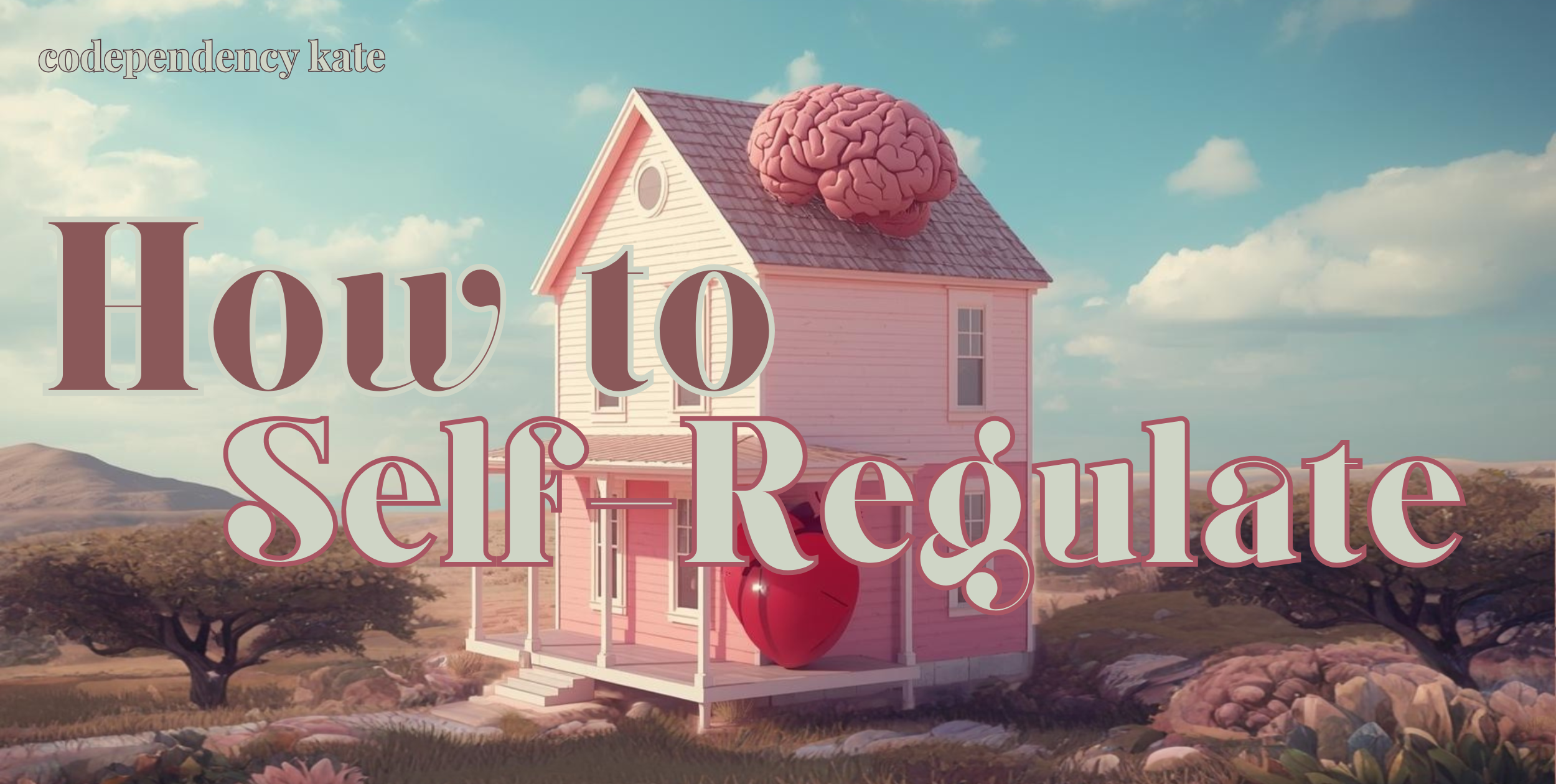
How to Self Regulate
All unwanted behavior comes from unmet needs. If we don’t view it this way, people’s behavior becomes fixed in our minds as labels or unhelpful beliefs about them. Eventually, this prevents us from connecting in relationships—with others, with ourselves, and most importantly, in how we parent our children in a connected, effective way.
We have a brain and a heart. Sometimes, when we process things only with our brain—by intellectualizing or ruminating—we get caught in unhelpful cycles and beliefs. This is often just unprocessed, unregulated emotion. It’s important to get in touch with how we feel about things, to get to the root of a behavior so we can understand it and then change it.
We can think of it like a house with a top floor (the brain) and a bottom floor (the heart).

The Brain-Heart House
When we’re stuck in our heads, looping over a problem, we sleep thinking about it, we wake up thinking about it, we talk to our friends about it. Our top floor becomes foggy. Overthinking, ruminating, pathologizing—these are all behaviors that come from dysregulation. Overthinking is a form of dysregulation. If we only stay on that top floor, thinking about the behavior, we end up creating core beliefs—about the situation, about ourselves, or about someone else.
The solution is to actually acknowledge your emotion. To figure out what’s really going on for you underneath the surface.
I talk more about how to get in touch with unmet needs and feelings in my other post on the BEND method.
Let’s explore what this looks like with an example.
Last night, my one-year-old went to sleep around 7:00 p.m. and woke up around 9:30 p.m. My husband and I split the night shift, and I thought I’d just settle her and put her back to sleep. But that’s not what happened.
I sat there with her, hoping she’d fall back asleep—but an hour passed, and then another. She was still awake.
I noticed myself—my behavior, my reaction. At first, I was okay. I enjoy one-on-one time with her. It was actually nice. I was watching TV, lying in bed, enjoying the snuggles. I wasn’t feeling inconvenienced, and I didn’t have unmet needs in that moment.
But by 10:45… then 11:45… she still wasn’t sleeping. By this point, I was feeling angry and frustrated. She was fussy, crawling over me, and I found myself getting mad at her—thinking angry thoughts about her.
At the same time, I was trying to figure out her behavior. Is she teething? Does she have a stuffy nose? What is she needing? I was in problem-solving mode—something we’re quite good at as parents. We constantly try to meet our kids’ needs. But I noticed that I was spinning: What’s wrong? What’s wrong?
That’s a symptom of my dysregulation.
So I stopped and asked myself: What am I feeling?
I noticed frustration, anger, tiredness, and exhaustion. And that awareness was the shift. I realized my anger wasn’t about her—it was about my own unmet needs.
When we’re dysregulated, we don’t have cognitive access to this kind of insight. So we have to sit with it.
And then it clicked—on a feeling level, from a deeper, wiser place: She’s one year old. She can’t take care of herself. This isn’t about her. This is about me.
What do I need?
Do I need a snack? Do I need to use the bathroom?
So I shifted focus from her to me and started problem-solving around my needs. I realized I was worried about sleep because I had work in the morning. It all made sense. My husband’s shift was supposed to start at 2:00 a.m., but by then, I’d already been at it for four hours.
I had reached my limit. I needed rest. So, I woke him up. I went to sleep. She fell asleep right after. Problem solved. No harm done.
All was good.
I woke up the next day, had six hours of sleep, and felt happy.
Why did everything turn out okay? Because I looked at my behavior and asked,
“What am I feeling? What do I need?”
If we don’t view behaviors—our own or our kids’—in this way, they turn into beliefs. In my head, I might have decided, “She’s just difficult,” or “I’m a bad mom.”
Our unprocessed feelings become facts in our minds. But the point of processing them is to create space for problem-solving. That’s what gives us direction. It’s how we stay connected i
instead of disconnecting—from ourselves, from our kids, or from our partners.
Resolution only happens when we allow ourselves to feel. Not just intellectualize.
It’s not about saying, “I’m angry—must be my trauma.” It’s about noticing, “I’m angry. Why? What are my unmet needs?” and then sitting with that.
Moving from intellectualizing to processing means shifting from “Why?” to “What?”
– Why is intellectualizing.
– What are my needs? That’s processing.
It takes time and practice. But it’s the most important skill.

Recommended Reading & Resources
There is so much information out there, it’s hard to know what’s what. Kate made this resource list to help. In it you’ll find books, podcasts, content creators, coaches, and organizations that share Kate’s values and beliefs as a licensed therapist.
Kate gets no kickbacks, commissions, perks, benefits, bonuses, or rewards for recommending any of these resources. She has no working relationship with any publishing house, authors, companies, content creators, coaches, or organizations. This resource list is a labor of love, from Kate, to help people find their way through the gray areas of life.
Self/Trauma
When I Say No, I Feel Guilty — Manuel J. Smith
The Mindful Self-Compassion Workbook — Kristin Neff & Christopher Germer
No Bad Parts — Richard Schwartz
The Will to Change — bell hooks
Running on Empty: Overcome Your Childhood Emotional Neglect — Jonice Webb
The Drama of the Gifted Child: The Search for the True Self — Alice Miller
The Courage to Be Disliked — Fumitake Koga & Ichiro Kishimi
Untamed — Glennon Doyle
Women Who Run with the Wolves: Myths and Stories of the Wild Woman Archetype — Clarissa Pinkola Estés
In Praise of Difficult Women — Karen Karbo
Be Ready When the Luck Happens — Ina Garten
Building a Life Worth Living — Marsha M. Linehan
Boundaries — Anne Katherine, M.A.
Wordslut — Amanda Montell
It’s Not Always Depression — Hilary Jacobs Hendel
The Easy Way to Stop Drinking Alcohol — Allen Carr
Complex Trauma: From Surviving to Thriving — Pete Walker
Burnout: The Secret to Unlocking the Stress Cycle — Emily Nagoski & Amelia Nagoski
ACEs —The CDC & Kaiser Permanente
Parenting / Reparenting
Unconditional Parenting — Alfie Kohn
Couples Counseling for Parenting — Stephen Mitchell, PhD & Erin Mitchell, MACP (Instagram)
Anything she’s ever written — Dr. Becky
Anything he’s ever written — Dan Siegel
Conscious Parenting — Dr. Shafali
Difficult Mothers, Adult Daughters: A Guide For Separation, Liberation & Inspiration —Karen C. L. Anderson
Daughters with Narcissistic Mothers: Dealing with a Self-Absorbed mother and Healing from Narcissistic Abuse. Recovering from Psychological Abuse and Emotionally Immature Parents — Alma S Bailey
Guiding Cooperative Children — Rachel Thomas
Marriage
Hold Me Tight: Seven Conversations for a Lifetime of Love — Dr. Sue Johnson
Boundaries in Marriage —Henry Cloud and John Townsend
Mating in Captivity — Esther Perel
Nonviolent Communication — Marshall Rosenberg
How to Keep House While Drowning — KC Davis
Fight Right — John & Julie Gottman
Shameless — Nadia Bolz Weber
Come As You Are — Emily Nagoski
Come Together —Emily Nagoski
Family Systems
The Drama Triangle — Salvador Minuchin
Bowen Theory — The Bowen Institute/Dr. John Bowen
Children of Emotionally Immature Parents — Lindsay Gibson
Spirituality / Deconstruction
Wild Mercy — Mirabai Starr
The Forbidden Female Speaks — Pamela Kribbe
The Christ Within — Pamela Kribbe
Searching for Sunday: Loving, Leaving, and Finding the Church— Rachel Held Evans
Sapiens: A Brief History of Humankind—Yuval Noah Harari
Separation of Church and Hate: A Sane Person's Guide to Taking Back the Bible from Fundamentalists, Fascists, and Flock-Fleecing Frauds — John Fugelsang
Christian Resources
Boundaries in Marriage — Henry Cloud and John Townsend
Love Does: Discover a Secretly Incredible Life in an Ordinary World — Bob Goff & Donald Miller
Refer a Therapist
Have your own therapist and want to refer them to others? Click here!
Find a Therapist Like Kate